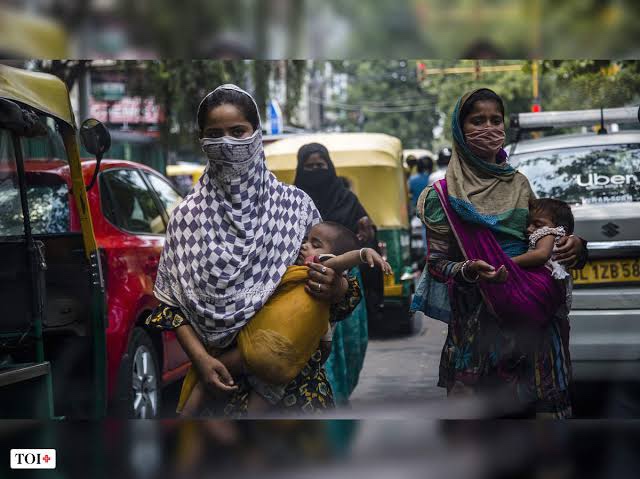
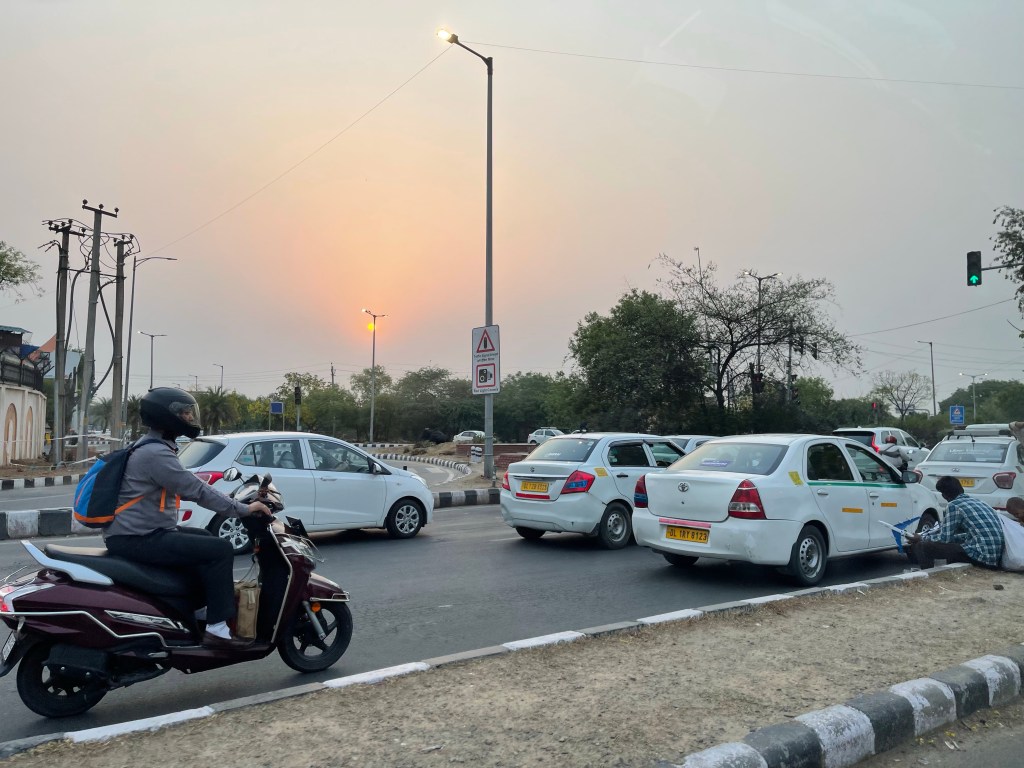
I could see her starting towards the car, having seen me watching her. She had been sat on the street side, baby in her arms, amidst a larger group of people. The street being a busy road full of the usual bustle that exists on the roads in India. The corner being a large intersection, with traffic signals that were actually adhered to.
She got up hurriedly having noticed my looking and rushed to the car window. She tapped the usual ‘tap tap tap’ on the window, her hand going to and from her mouth simulating the gesture of eating. The request for money, the pleading stare. The baby nestled in one arm, oblivious to the details of the circumstance.
I glanced at the countdown timer next to the traffic signal, ticking down how long before the lights would go green. 72 seconds to go. 72 seconds of her pleading ahead.
It is a sight I have seen many times. It is always awkward, and I shamefully admit I never really know where to look, often giving the negative wave gesture, then looking straight forwards ignoring the constant tapping and pleading.
It is prevalent at busy intersections where the cars stop and are forced to queue – however unorderly – giving the beggars (for want of a better term) the chance to work the line going up and down tapping on windows asking for help. Regularly these are young woman, with babes in arms as per my experience above.
Sometimes they are young children, often in small groups. This last week I had a young boy with one arm who waved the stump of his lost arm at me, only to then raise his shirt and show me the most horrific scar on his belly which must have been the result of some surgery or major trauma, the scar line having signs of stitching up and down on either side. The remnant state of the scar implying that whatever caused it, and its repair, was not to the highest standard to say the least. There are stories that gangs maim children in order to stimulate more pity, and hence more donations, although I cannot attest to the truth of this. I hope that does not really happen.
Of course the obvious question is whether to give money or not. Rightly or wrongly I have not yet made any donations to these people. Partly because it would likely result in a rush of others to the car, all crying out for the same. Rarely are these beggars alone, and they all keenly watch each other for signs of success, and in that situation they will move quickly to try and also secure money from the more generous and rare donator.
There is also supposedly a lot of alleged gang activity which control some elements of these beggars. If it is true as described then often any money provided actually goes to the gang lord with only small amounts given to the actual beggars themselves. The same reports describe the women with babies as sometimes borrowing these babies from their real mothers to make a more pitying scene and hence get more donations. I cannot of course confirm how many of these beggars are legitimately in need or part of these gangs, but official advice is to not give money to prevent fuelling the phenomena further.
It is also a matter of frequency, as this occurs so often that at what point to give, and at what point to not give. There is one particular corner which I routinely pass on my way home from work, and if the lights are red then you can be sure the tap tap tap will occur.
An interesting nuance to this corner is that often it is a location for the lady boys to beg also. These ‘guys’ are part of organised groups in India which give you a blessing in return for a donation by simply touching your arm. This is considered good fortune by many, and so they tend to get much more in terms of donations.
Also these traffic intersections are home to a wide variety of vendors who patrol up and down the queuing cars selling a range of items. I have seen paper aircraft, bunches of flowers, car sun visors, and even somebody carrying a collection of books providing a rather unusual version of a mobile bookstore. How anyone would have the time to browse through which books he had and make a selection under such circumstances is beyond me, but it is all about being opportunistic and he must have some success. So long as somebody buys something then it is cash they didn’t have in the first place. And given the levels of cash income that prevails among these street people, a small amount will go a long way.
Yesterday I paid a rickshaw driver 200 Rupees (about £2) for a 3 mile or so journey back from the local Mall. We had originally agreed 150 Rupees (it is normally about 100 Rupees for the trip I know from experience but he was a good haggler and so I relented) and then we got caught in heavy traffic so it took a lot longer than expected.

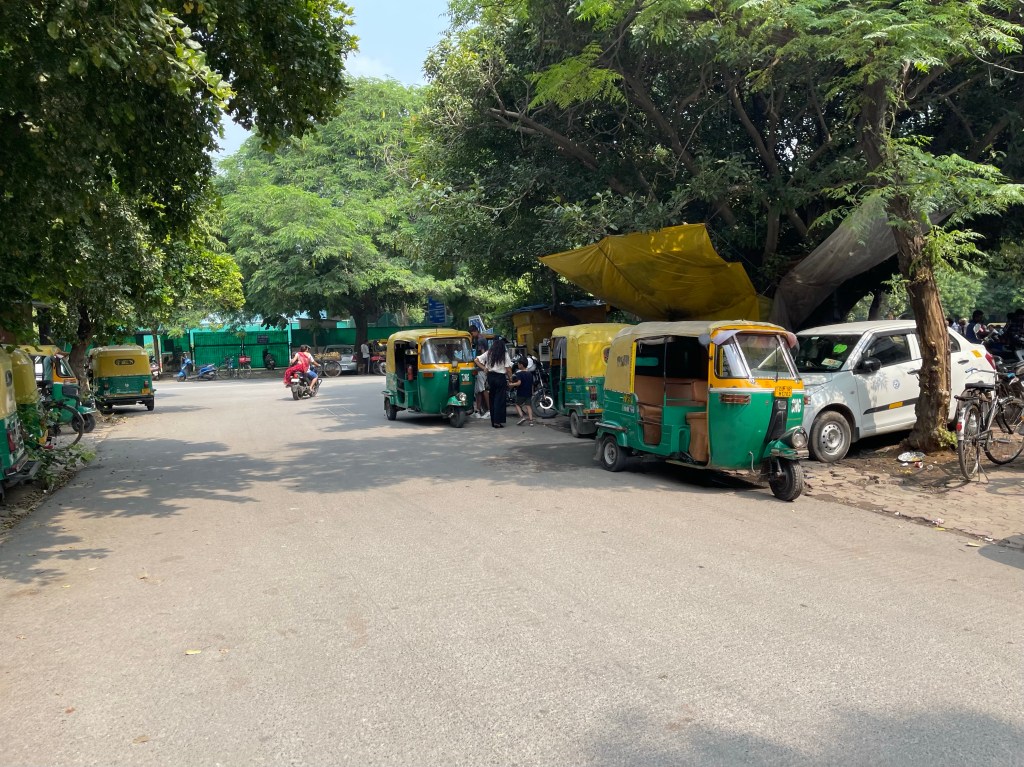
He asked if I could give him a bit more as a result and having only a 200 Rupee note I was happy enough to just let him have it and not seek the change. He was delighted and so appreciative, you could see his face light up when I gave it to him. In western terms that is not a lot for a ‘taxi’ for such a journey, but considering the competition amongst auto rickshaws (as they are properly known), paid journeys are not that forthcoming and I can only guess at how much (or probably more accurately how little) money they actually take home each day. And that’s if they go home. I arrived back late off a flight a few weeks back and only got to the apartment at around 1am. As I passed the line of rickshaws parked up around the corner from my place most of them had their drivers sprawled out in the back asleep, legs dangling over the side, hanging out into the street.
Our perspective on income and wealth is very different. As I have said in previous posts, the housekeeping scene here sees my ‘maid’ earning around £40 a month for probably a total of about 20 hours work – which at an hourly rate level is actually pretty good for such a role.
Without breaching confidences and respectful of privacy I can share that there are admin people working for companies I know around here that receive about £200 a month for full time work. In fact part of my sales patter for our new airport in Goa is that the Goa region of India has one of the highest per capita incomes in the country, with around 40% of households there having an annual income greater than US$10k. Our pitch talks to that, demonstrating it as a region with a population that has disposable income, and a propensity for travel.
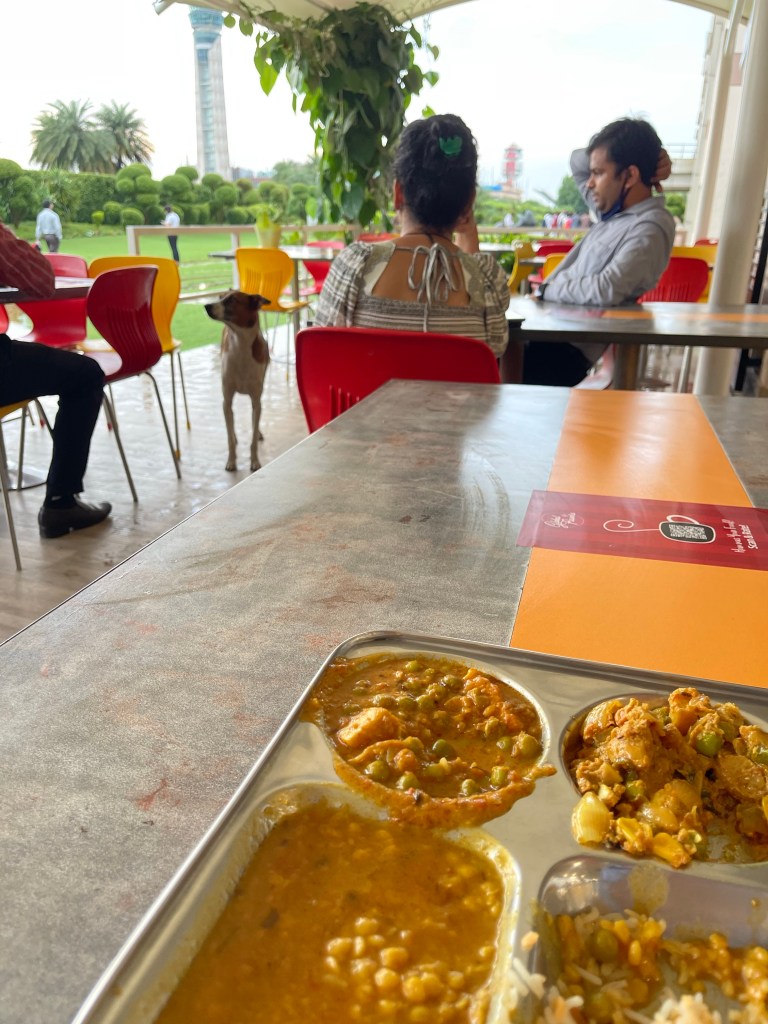
So the benchmark here is lower than we see in the Western world, and as a result the cost base aligns around that. My lunch in the office canteen costs me around 80 pence equivalent for a good Thali dinner (plus I get a good view of the air traffic control tower and the occasional street dog to accompany me while eating)!
An expensive main course in a nicer restaurant would probably be no more than £5 equivalent, which by local standards is pricey. Somewhat surprisingly Dominoes Pizza is actually relatively expensive by local standards and for me to order a large pizza (lasts me for two days) would generally cost me around £8 including delivery. I usually cringe when the security guard brings it up to my door as the receipt is printed on top and I am sure he is all to aware that the pizza costs more than he will probably have earned for his twelve hour shift that day sitting outside in the heat.
There is a different level to all this though, in that there are polar extremes, with sometimes very evident levels of wealth among the few. It is a bit of a stereotype admittedly, but displaying wealth is quite the norm if it is had, with the designer clothes, sunglasses on a cloudy day, and the expensive handbags on show. For a country with such chaotic driving and often beat up cars bearing the scars these roads inflict, there are a surprising array of flashy cars around. Seeing 5 series BMW’s and E-class Mercedes is actually quite common.
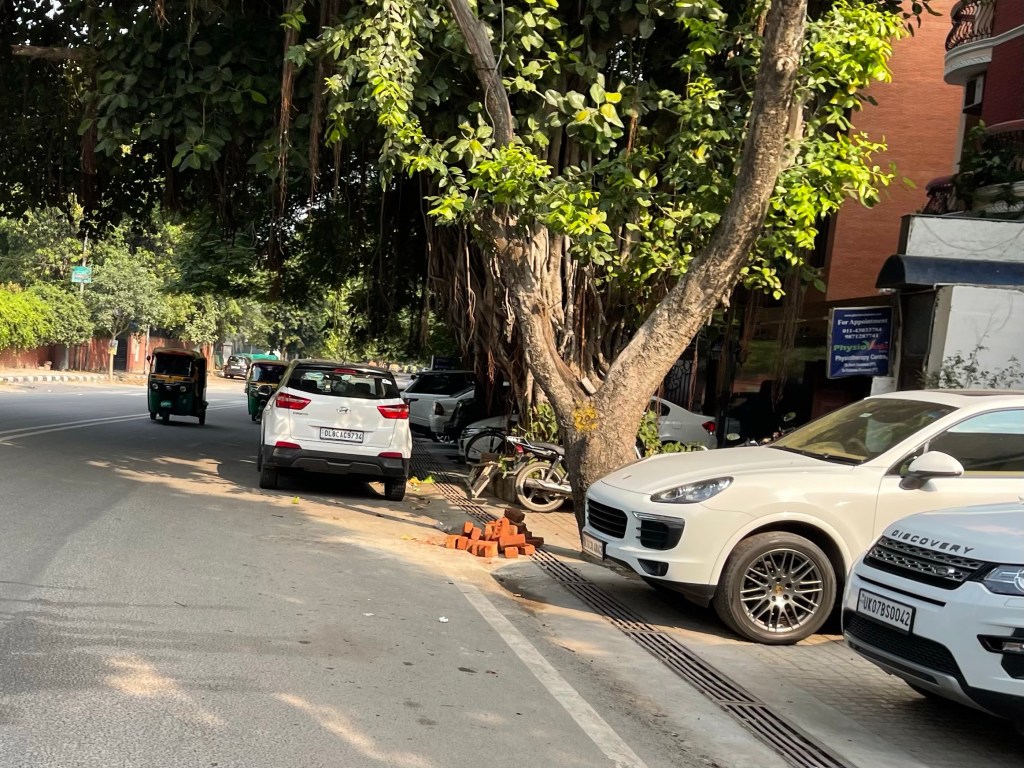
My realisation of this is that actually having wealth in India is not something to be ashamed of or to hide. In the west there will be some who exhibit their wealth in similar ways, but I also believe often it can be more subtle with people being less exhibitionist about it.
But here in India, in a country of competition to survive, there seems to be an acceptance that some have, and some have not. Those that have are looked up to, and from what I have seen it is less from a perspective of envy but more from a sense of acceptance. The beggars at the car doors, those who earn so very little, do not seem to despise those who have more. Instead there is an understanding and an acceptance that this is the way of things, and so instead the focus is on how to survive best in their individual circumstance.
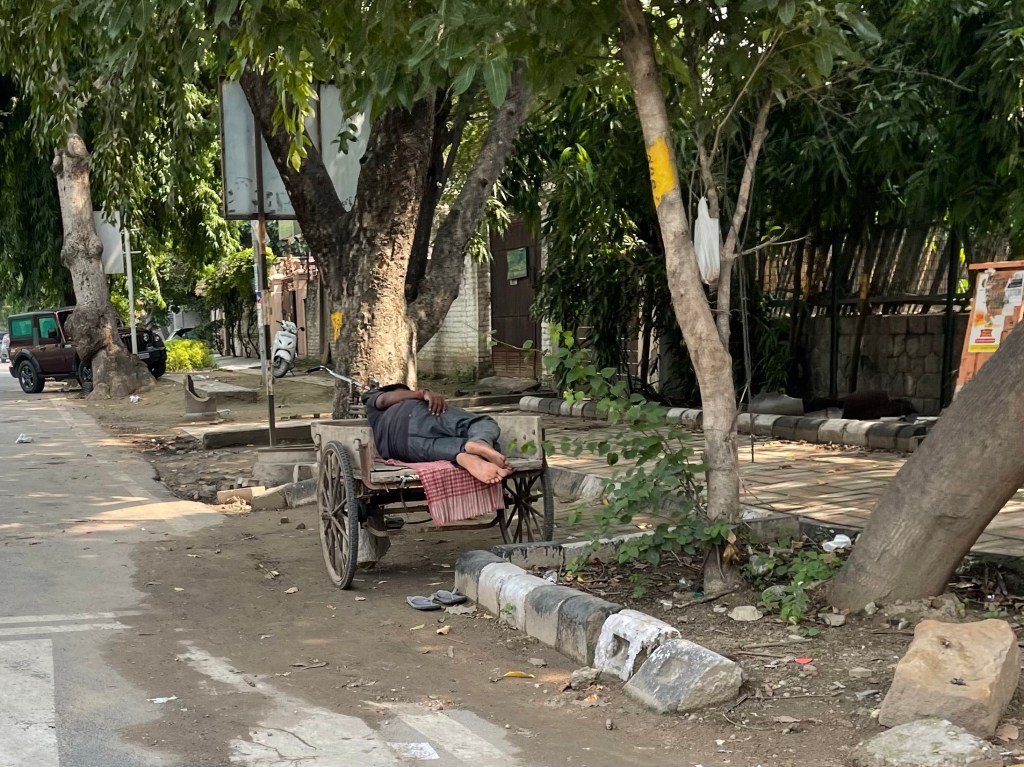
I have said before that poverty does not necessarily translate to danger. The poorest of the poor do not pose a threat just because they do not have much (or any) money. Of course there will be exceptions here in India as there will be anywhere in the world, but it is not prevalent here and I believe it is safer here than in many other places in this world.
Plus, the acceptance of status leads to an attitude of making the best of it, as I experienced in the Holi festival when some of the slum guys nearby were partying merrily, and seemingly happy to share the experience with me. I have driven past slums regularly where you see the children out playing cricket with improvised stumps and equipment. In fact only this last week I was flying out of Mumbai taxiing past the slum that exists right next to the airport and is easily visible from the aircraft seat.
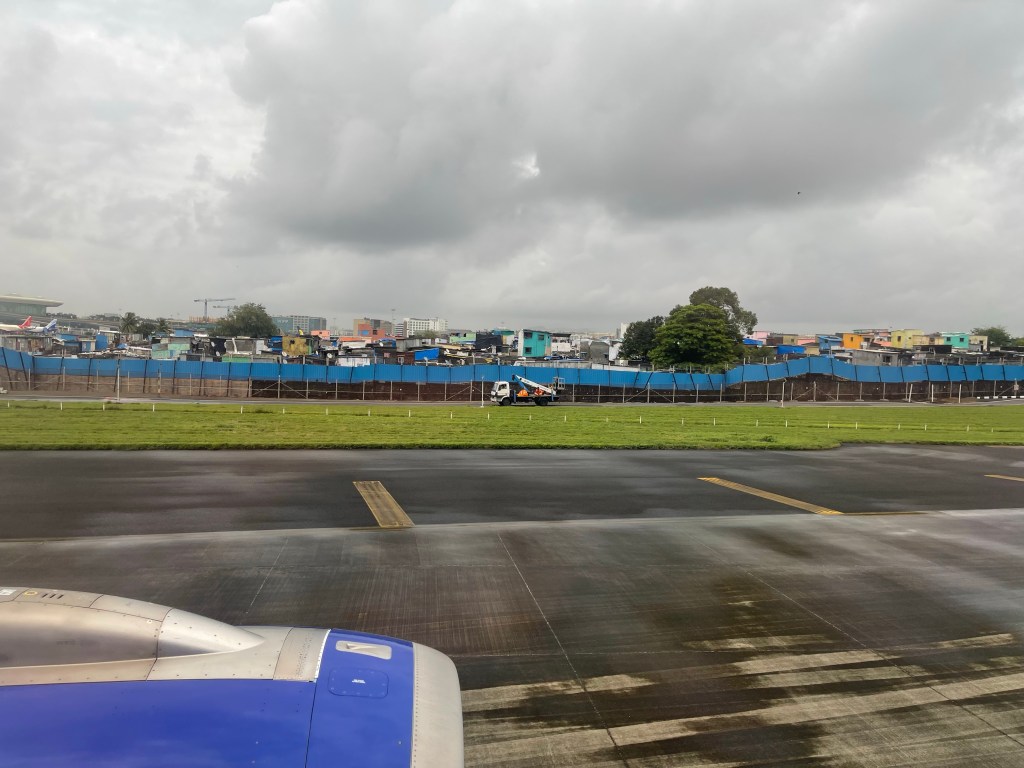
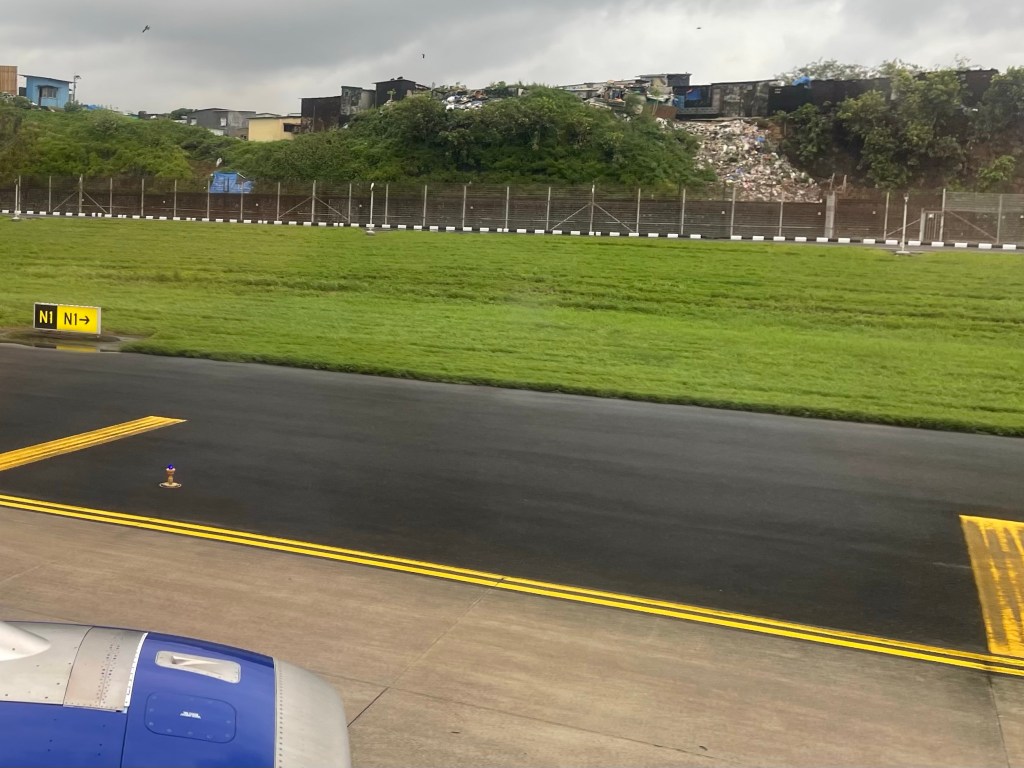
There was what seemed like a major cricket game going on in the adjoining fields and it looked to be a real festival atmosphere. That particular slum is one I have been familiar with for many years, as ever since I have been coming to Mumbai relatively frequently I would always see the large hill of rubbish and waste that spills down a hill towards the airport perimeter. Sitting in a plush business class seat on an Emirates aircraft while looking down on it is quite a humbling experience. Yet just around the corner from this hill of waste the cricket carnival was occurring. It is about making the best of the circumstance and not spending a life wallowing in pity.
I’m not defending the poverty situation though, nor am I saying that people in these circumstances are happy to be in this environment. But it is what it is, and the underlying attitude of acceptance and living the best they can is what matters, and keeps this country moving the way it does.
The young girl at the car window, baby in arm, hand going to and from her mouth, pleading for money wasn’t giving up. The 72 seconds were counting down painfully slowly. I was sat there in my Uber with the air conditioning on, heading back from a dinner with some visitors in an expensive local hotel. I was going back to the comfort of my top floor apartment with a comfortable bed to look forward to. The gulf between myself and this girl was immense, and yet we were separated by mere centimetres.
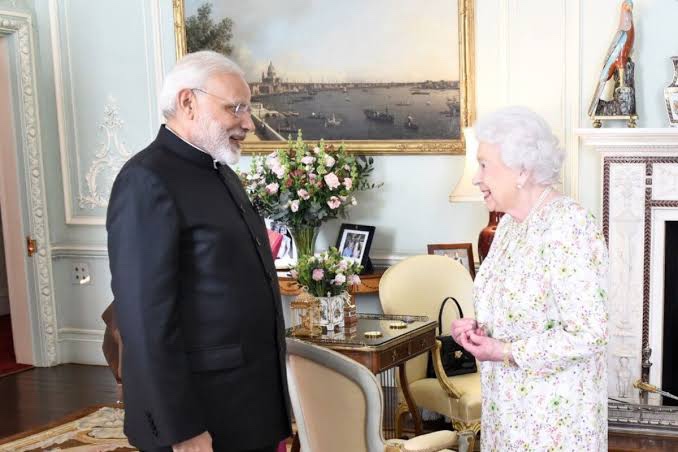
To end this post it is only appropriate to note that tomorrow is the Queens funeral. I personally never met the Queen, and ironically my only Royal encounter was with Prince Edward in Mumbai a few years ago while he was speaking at a business event I was also attending. Even then I didn’t speak to him, just watched him walk past amidst his hefty entourage. I believe the manner and respect of the last week has done the UK and the Royal family proud. I am fortunate enough to have been invited to watch the funeral tomorrow at the British High Commissioners residence here in Delhi, something I am honoured to do and I look forward to showing my respects in this way.
I expect as I sit in the back of my Uber tomorrow on the way to the event, wearing my best suit, there is every possibility I shall experience the tap tap tap on the window at some point. That gulf between us, being no more evident than under such circumstance, will continue to be so far whilst still being so close.
The Queen is dead. Long live the King.
 JC in India
Leave a comment